Tyr · Gly · Gly · Phe · Leu — C₂₈H₃₇N₅O₇ — an endogenous opioid pentapeptide

YGGFL

The painkiller you cry.

Five amino acids the body makes for itself — a δ-opioid peptide reported in emotional tears, stronger than morphine in certain isolated assays, and gone within seconds because our own enzymes tear it apart. Panacea Bio Chem synthesised it, and is investigating how to make it last.

The sequence — Tyr–Gly–Gly–Phe–Leu

Y
Tyr
G
Gly
G
Gly
F
Phe
L
Leu

The Tyr¹ "message" residue is what the opioid receptor reads. Enkephalinases cut between Tyr¹–Gly² and Gly³–Phe⁴ — two snips, and the signal is gone.

01 — The molecule

The body's own morphine — with an asterisk.

Leu-enkephalin is an endogenous opioid: a signalling molecule your own neurons release. It leads at the δ-opioid receptor, with activity at μ as well — a different receptor emphasis from morphine, and part of why its pharmacology is so distinct.

Discovered in 1975 as one of the brain's native opioids, Leu-enkephalin (Tyr-Gly-Gly-Phe-Leu) is a pentapeptide agonist principally at the δ-opioid receptor, with secondary μ-opioid activity. The δ emphasis links it to mood, anxiety and analgesia in ways that are not simply "a weaker morphine."

Is it really stronger than morphine? Only with a careful qualification. In the isolated mouse vas deferens assay, enkephalins have been reported as 30–60× more potent than morphine. In the guinea-pig ileum, Leu-enkephalin shows only around a quarter of morphine's activity (Waterfield et al., Eur J Pharmacol 1977). Apparent potency depends heavily on the receptor population, tissue, route and endpoint — so "more potent than morphine" is true in a dish, and not a universal or clinical claim.

Receptor emphasis

δ over μ

Primary agonism at the δ-opioid receptor (associated with mood and analgesia), with μ-opioid activity as well. The δ-leaning profile is the scientifically interesting part — and the reason enkephalin-based approaches are studied for pain, depression, anxiety and craving rather than as classical opioids.

Potency, honestly

Assay-dependent

30–60× morphine in mouse vas deferens; ~25% of morphine elsewhere. The number is real in each case — it is the context that decides. We quote both, and claim neither as the whole story.

02 — Discovery & origin

The year the brain was found to make its own morphine.

In 1975, two peptides overturned a century of pharmacology: the body doesn't just respond to opioids — it manufactures them.

Working at the University of Aberdeen, John Hughes and Hans Kosterlitz isolated two closely related pentapeptides from pig brain with potent opiate-agonist activity, and published them in Nature: Met-enkephalin (Tyr-Gly-Gly-Phe-Met) and Leu-enkephalin (Tyr-Gly-Gly-Phe-Leu). The name they chose — enkephalin, "in the head" — captured the shock of it: morphine's receptor existed because the brain had a molecule of its own to fit it. The work earned the 1978 Albert Lasker Award and reframed pain, mood and addiction at a stroke.

The two differ by a single residue at position five — Met or Leu — and that one swap tunes stability and receptor behaviour. YGGFL, the leucine form, is the subject of this site.

Where it comes from — biosynthesis

Proenkephalin (PENK)

Leu-enkephalin is cut from a large precursor, preproenkephalin — the 267-amino-acid product of the PENK gene on human chromosome 8q12.1 — by proteolytic processing in the secretory pathway. A single PENK molecule yields several enkephalin copies, which is how one gene supplies a system spanning brain, cord and periphery.

It is found in the brain, spinal cord, gastrointestinal tract, adrenal medulla, heart, kidney and blood vessels — not a niche neurotransmitter, but a body-wide signalling peptide.

03 — The fragility

Nature built a painkiller, then built the scissors.

The reason Leu-enkephalin is not a systemic drug is not weakness — it is speed of destruction. Two enzymes, the enkephalinases, dismantle it almost the instant it appears.

Enzyme 1 · NEP

Neprilysin

The neutral endopeptidase neprilysin (NEP) cleaves the Gly³–Phe⁴ bond, severing the peptide's business end from its opioid "message" residue. One cut and the signal collapses.

Enzyme 2 · APN

Aminopeptidase N

Aminopeptidase N (APN) removes the N-terminal Tyr¹ — the exact residue the opioid receptor recognises. Take Tyr away and there is nothing left to read.

Consequence

A half-life in minutes

Between NEP and APN, native Leu-enkephalin survives only minutes in plasma — control t1/2 11.8 ± 1.0 minutes in human plasma (Mosnaim et al., Am J Ther 2004, PMID 15543085); effectively instantaneous at the synapse. It was never designed to travel — only to whisper, locally, and vanish.

This is the whole engineering problem in a sentence: the molecule works, but the body erases it faster than it can act at a distance. Classical pharmacology's answer has been the enkephalinase inhibitor — thiorphan (the active form of the marketed drug racecadotril), bestatin, RB-101, and the dual enkephalinase inhibitors (DENKIs) that block NEP and APN together, raising the half-life and the physiological action of the body's own enkephalins. Panacea's work begins here.

04 — What it does in the body

Not just pain — a whole-body regulator.

Because it is released body-wide and leads at the δ-opioid receptor, Leu-enkephalin sits at the crossroads of pain, mood, the heart, immunity and the gut. This is what the literature attributes to the enkephalin/δ-opioid system.

Pain

Analgesia, natively

The founding role: enkephalins dampen pain signalling at spinal and supraspinal sites through opioid receptors — the body's own analgesic tone. Blocking their breakdown raises that tone without administering an external opioid.

Mood & reward

An endogenous antidepressant

δ-opioid-receptor–deficient animals show depression- and anxiety-like behaviour; inhibiting enkephalinase produces antidepressant-like effects, and δ-agonists rival diazepam-like anxiolysis in models. Enkephalin tone in the nucleus accumbens and VTA shapes mood, motivation and reward.

The heart

Cardioprotection

The heart makes its own enkephalins and releases them under brief ischaemia or exercise. Through δ-opioid receptors they drive ischaemic preconditioning — brief stress that protects against later injury — and shield cardiomyocytes when oxygen runs low.

Immunity

Inflammation-modulating

δ-opioid agonists ease experimental colitis, lower inflammatory IL-6 and shift regulatory T-cell populations — evidence that the enkephalin system speaks directly to immune cells, not only to neurons.

The gut

Motility & secretion

Enkephalins regulate gastrointestinal motility, secretion and intestinal integrity — the same biology that makes the peripheral enkephalinase inhibitor racecadotril an anti-diarrhoeal medicine.

Cells & survival

Neuroprotection & growth

Beyond signalling, the δ-opioid receptor and its enkephalin ligands are implicated in cellular growth, ischaemic tolerance and neuroprotection — a molecule involved in keeping tissue alive under stress.

05 — Making it last is not new

The enkephalinase-inhibitor landscape.

Pharmacology has spent decades on exactly Panacea's problem — how to make the body's enkephalins last — and the tools it built are the foundation this programme stands on. One of them is quietly astonishing.

Synthetic inhibitors

From a diarrhoea drug to CNS agents

Thiorphan — the active form of the marketed drug racecadotril — inhibits neprilysin peripherally and is used for acute diarrhoea. RB-101 crosses into the brain and, by protecting central enkephalins, acts as an analgesic, anxiolytic and antidepressant, and eases opioid withdrawal in models. Bestatin (ubenimex) and D-phenylalanine round out the classic set. These are the DENKIs — dual enkephalinase inhibitors — that block NEP and APN together.

Endogenous inhibitors — the marvel

Opiorphin: your saliva already does this

The body makes its own enkephalinase inhibitors. Opiorphin — a five-residue peptide (QRFSR) secreted in human saliva — is a dual NEP/APN inhibitor that has shown antidepressant-like effects in models — Panacea's reading of the preclinical literature puts it at roughly 30× the antidepressant potency of RB-101 (a Panacea-reported figure; the published abstracts show the antidepressant-like activity without a direct RB-101 comparison). Its cousins are sialorphin (rat) and spinorphin (bovine).

The remarkable part: repeated opiorphin produced no dependence, no tolerance, and no reward in animal tests — analgesia and mood benefit through the body's own opioids, without the addiction signature of morphine. That is the north star of this entire field.

The lesson Panacea takes from this landscape: you do not need to build a new opioid to get an opioid's relief. You protect the one the body already trusts. Enkephalinase inhibition supplies the protection; a depot supplies the duration.

06 — The tears

Emotional tears are chemically not the same as onion tears.

Cry from grief and cry from chopping an onion, and the same glands make two different fluids. The emotional one carries cargo the reflex one does not.

Reflex tears — from dust, wind, an onion's sulphur vapour — are essentially irrigation: wash the surface, protect the cornea, done. Emotional (psychogenic) tears, the ones that come with intense feeling, have been reported to carry a richer chemistry: higher protein, and measurably more Leu-enkephalin, prolactin and ACTH than irritant tears.

That is a striking observation. It means the act of emotional crying is accompanied by the appearance of an endogenous opioid peptide and stress-axis hormones in the fluid itself — the body's chemistry of feeling, made visible. Whether the tears deliver anything, or merely reflect the state that produced them, is a genuinely open question — and the subject of the next section.

Leu-enk
δ-opioid peptide, ↑ in emotional tears
Prolactin
↑ reported in emotional tears
ACTH
stress-axis hormone, ↑ reported
Reflex
irritant tears — irrigation, not cargo
07 — The wonder

Are we built to cry so we can shed cortisol and the stress-axis hormones — or is the older design that tears run down into the mouth, so that under real duress the body doses itself with its own opioid peptide?

It is one of the more beautiful open questions in human physiology, and worth stating plainly as a question. The tidy modern reading is release: emotional crying exports stress hormones, and the relief is partly getting rid of them. But there is a second, provocative reading. Tears do not only fall — they drain, through the nasolacrimal duct, into the nasopharynx, and onward. That is a mucosal route: precisely the kind of surface across which small peptides can be absorbed. A molecule too fragile for the bloodstream can still act where it lands.

So which is the purpose — the export of cortisol, or the quiet self-administration of a δ-opioid peptide at the very moment a body most needs comfort? We do not claim to know. We find it a compelling enough question that it named a research programme. Framed honestly, it is a hypothesis, not a finding.

08 — The Panacea programme

Synthesise it. Protect it. Make it last.

Panacea Bio Chem's competence is formulation and solid-state science — the discipline of turning a fragile molecule into a stable, delivered one. Leu-enkephalin is almost a textbook case: the pharmacology is established; the problem is entirely one of survival and delivery.

Panacea has synthesised YGGFL by standard solid-phase peptide synthesis. The programme below — protecting it from enkephalinases and extending it through a depot — is stated as research and design targets, not clinical outcomes. Where the science is established, it is cited as the field's; where a claim is ours, it is marked as a hypothesis under test.

Approach 1 · protection

Blunting the scissors

Rather than re-engineer the natural peptide, the programme co-formulates it with enkephalinase inhibition — the DENKI principle of blocking neprilysin and aminopeptidase N so the body's own erasers act more slowly. The aim is to let a natural sequence behave like a durable one, without changing what it is.

Approach 2 · the depot

From seconds to weeks

The delivery half is a biodegradable microsphere depot — the protected peptide dispersed in PLGA microspheres for a slow, sustained release, converting a molecule that survives seconds in free solution into one metered out over weeks from a single depot.

Half-life — native vs protected-and-depoted (illustrative)

native — seconds protected depot — weeks dose ~4 weeks Cₚ

Illustrative design target — not measured patient data. The native curve is Leu-enkephalin's real problem; the plateau is the programme's goal.

Lead hypothesis · design target under investigation

A single depot of a protected natural opioid peptide.

The programme's design target is a protease-protected Leu-enkephalin microsphere depot delivering a sustained, sub-analgesic-to-analgesic tonic of the body's own δ-opioid peptide over roughly four weeks from one injection — pairing enkephalinase inhibition with PLGA depot release. This is a preclinical objective and a hypothesis under test, not a demonstrated clinical outcome or a treatment.

Basis: enkephalinase inhibitors (thiorphan/racecadotril, RB-101, DENKIs) are established and shown to extend enkephalin action; PLGA depots routinely give weeks-to-months of release. Combining them for a protected endogenous opioid peptide is the novel, and unproven, element.

What is claimed — and what is not

Claimed: synthesis of the peptide, a defined protection-and-delivery strategy, and a design target. Not claimed: any human efficacy or safety result, dose recommendation, synthesis route, or regulatory status. Leu-enkephalin acts on the opioid system; nothing here is medical advice or an offer to supply, and no one should infer a treatment from this page.

09 — In the investigator's words

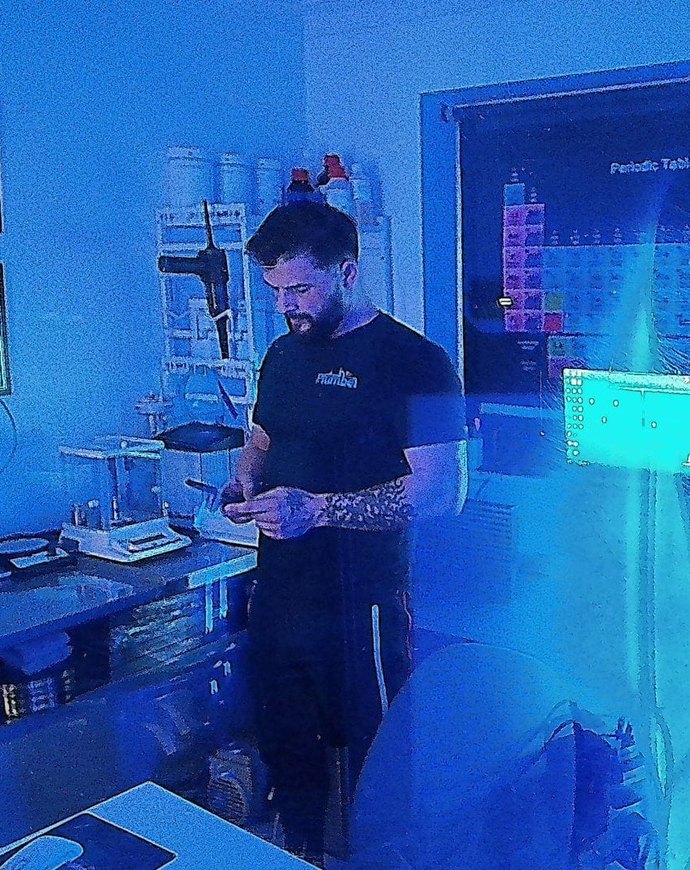
Bogdan Dicoias — Panacea Bio Chem R&D laboratory
"The body already invented the drug. It even carries it in tears. Our job was never to improve the molecule — it is to defend it: slow the enzymes that erase it, and give it a depot so it can act longer than a heartbeat. Making the transient permanent — that is the whole of the work."

— Bogdan Dicoias, Panacea Bio Chem

10 — Enquiries

Collaboration & correspondence

Peptide synthesis, protease-protection chemistry, depot formulation and analytical partnership are welcome. This is a research site — not a clinic and not a supplier.

contact@panaceabiochem.com →

Boundaries, stated plainly

Leu-enkephalin is an opioid-system peptide and an investigational research compound. Nothing on this page is medical advice, a dosing guide, a synthesis route, or an offer to supply, and no claim of safety, efficacy or regulatory approval is made for any Panacea Bio Chem work described here. Reported clinical and physiological findings belong to their original researchers and are cited as theirs.

11 — Sources

References & further reading

12 — Frequently asked questions

Frequently asked questions.

The molecule

What is YGGFL?

YGGFL is the one-letter sequence of Leu-enkephalin — Tyr-Gly-Gly-Phe-Leu — a pentapeptide the human body makes for itself. It is an endogenous opioid: an agonist principally at the δ-opioid receptor, with secondary μ-opioid activity, found in brain, spinal cord, gut, adrenal medulla, heart and blood vessels.

Potency, honestly

Is Leu-enkephalin really stronger than morphine?

Only in certain isolated assays. In the mouse vas deferens preparation, enkephalins have been reported as 30–60× more potent than morphine; in other preparations Leu-enkephalin shows about a quarter of morphine's activity. The figure depends on receptor population, tissue, route and endpoint — true in a dish, not a universal or clinical claim.

The fragility

Why is Leu-enkephalin not already a medicine?

Speed of destruction. Neprilysin and aminopeptidase N — the enkephalinases — dismantle it within moments in plasma, so it acts locally and vanishes. Enkephalinase inhibitors (thiorphan/racecadotril, RB-101, bestatin) and the body's own opiorphin show the peptide can be protected; duration is the engineering problem.

The programme

What is Panacea Bio Chem's programme with YGGFL?

Panacea has synthesised YGGFL by standard solid-phase peptide synthesis and is investigating two design targets: co-formulation with enkephalinase inhibition to slow its breakdown, and a biodegradable PLGA microsphere depot for sustained release over weeks. These are preclinical research targets and hypotheses, not demonstrated clinical outcomes.

Boundaries

Is anything on this site medical advice or an offer to supply?

No. Leu-enkephalin is an opioid-system research compound. Nothing here is medical advice, a dosing guide, a synthesis route, or an offer to supply, and no claim of efficacy or regulatory approval is made for any Panacea Bio Chem work described here.

13 — Trending in the field

Trending in the field

The Panacea Technology Universe

26 technologies, each the leader of its class

Proprietary Panacea Bio Chem Ltd technologies, invented by Bogdan Dicoias — what each one does, and why it leads its class.

Lyoprester® — Panacea Bio Chem technology by Bogdan DicoiasLyoprester®The only dual-chamber cartridge that is autoreconstitution-enabled, vacuum-sealed and argon-fillback.lyoprester.com ↗P-EARLs — Panacea Bio Chem technology by Bogdan DicoiasP-EARLs™Panacea-Engineered Aseptic Reconstitution Liquid(s) — each tuned to the peptide it wakes.p-earls.com ↗Peptourbillon — Panacea Bio Chem technology by Bogdan DicoiasPeptourbillon™The layered peptide formulation architecture — single- or multi-layer, never a blend.peptourbillon.com ↗RF Tunnel — Panacea Bio Chem technology by Bogdan DicoiasRF Tunnel™The RF-formed central channel through the cake.rftunnel.com ↗TgShift — Panacea Bio Chem technology by Bogdan DicoiasTgShift™Raises the cake’s glass-transition temperature with RF — instead of chilling below it.tgshift.com ↗Cryolapse — Panacea Bio Chem technology by Bogdan DicoiasCryolapse™Cryogenic pressure collapse under S3Pulse™ control — vapour redistributed through the whole cake, not its surface, impeding crust formation.cryolapse.com ↗LyoLevit — Panacea Bio Chem technology by Bogdan DicoiasLyoLevit™The cake levitates and spins in high orbit — driven by ultrasound and RF.lyolevit.com ↗Lyochrysalis — Panacea Bio Chem technology by Bogdan DicoiasLyochrysalis™The integrated chamber housing the whole drying stack.lyochrysalis.com ↗S3Pulse — Panacea Bio Chem technology by Bogdan DicoiasS3Pulse™The control brain for every piece of Panacea hardware.s3pulse.com ↗Liquiprester — Panacea Bio Chem technology by Bogdan DicoiasLiquiprester™The single-liquid cartridge engineered so multiple peptide APIs coexist in one shared vehicle.liquiprester.com ↗Syntheseract — Panacea Bio Chem technology by Bogdan DicoiasSyntheseract™Continuous-flow peptide synthesis in a special, very fast and economical way.syntheseract.com ↗CFSPPS — Panacea Bio Chem technology by Bogdan DicoiasCFSPPS™Continuous-flow solid-phase peptide synthesis, written as its own category.cfspps.com ↗OxyDeplete — Panacea Bio Chem technology by Bogdan DicoiasOxyDeplete™Degassing plus no-headspace doctrine — the oxygen-starved seal.oxydeplete.com ↗ArgonLock — Panacea Bio Chem technology by Bogdan DicoiasArgonLock™The final inert-atmosphere lock under argon.argonlock.com ↗RedoxVault — Panacea Bio Chem technology by Bogdan DicoiasRedoxVault™Separation, not merely suppression — redox isolation in lipid micro-reservoirs.redoxvault.com ↗PleniDose — Panacea Bio Chem technology by Bogdan DicoiasPleniDose™The shared filling gantry — one machine filling both the dual-chamber Lyoprester and the liquid Liquiprester.plenidose.com ↗IncreSure — Panacea Bio Chem technology by Bogdan DicoiasIncreSure™The dose-metrology layer — verified API per pen increment.incresure.com ↗ElimiVoid — Panacea Bio Chem technology by Bogdan DicoiasElimiVoid™Front-void elimination without touching the metered dose.elimivoid.com ↗Cryoviscous — Panacea Bio Chem technology by Bogdan DicoiasCryoviscous™The characterised cold, high-viscosity, low-mobility conditioning state.cryoviscous.com ↗
Vana Machine — Panacea Bio Chem technology by Bogdan DicoiasVana Machine™Vacuum Assisted Needle Accessory — vacuum conditioning and plunger-locking for the cartridge.
EZnject — Panacea Bio Chem technology by Bogdan DicoiasEZnject™The disposable auto-injector pen built around the Lyoprester.panaceaeznject.com ↗Dicoias Ψ — Panacea Bio Chem technology by Bogdan DicoiasDicoias ΨThe computed-chemistry advisory — every substance reduced to a vector across physical, electronic and formulation space.dcppsi.com ↗SealoPrester — Panacea Bio Chem technology by Bogdan DicoiasSealoPrester™Aseptic Cartridge Closure System — Seal o’ Precision + Sterility.sealoprester.com ↗Peptidic Liquid — Panacea Bio Chem technology by Bogdan DicoiasPeptidic LiquidThe peptide formulation in solution — the active plus its buffers, cryoprotectants, lyoprotectants and scaffolders.peptidicliquid.com ↗DiastolVAC — Panacea Bio Chem technology by Bogdan DicoiasDiastolVAC™Biomimetic diastolic vacuum control — the pneumatic circulatory system of the machine: pumps, valves and sensors as one ensemble.diastolvac.com ↗KineticON — Panacea Bio Chem technology by Bogdan DicoiasKineticON™Motion Integrity Architecture — the motion-control layer that lets the machine know what happened on every axis move.kineticon.org ↗

Weekly review — 14–20 Sep 2026

The publications indexed in PubMed in the last 30 days for "Leu-enkephalin" OR "YGGFL" already appear in Trending above — the next most recent in the field, refreshed weekly.

